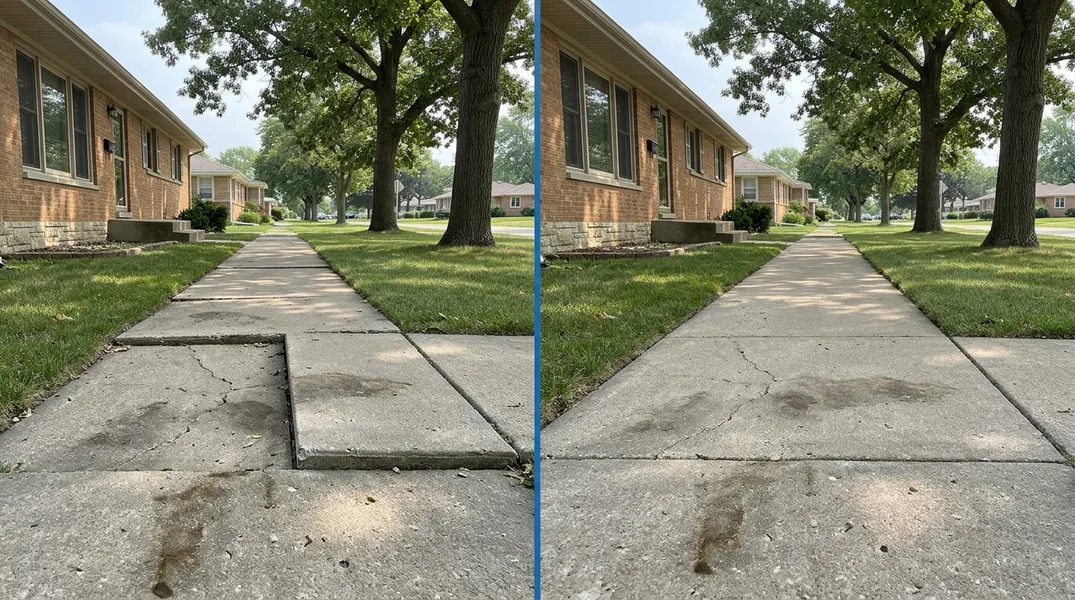
Understanding Frost Heave and Joliet's Unique Geology
If you own a home in Joliet, you've likely noticed that your driveway, patio, or foundation doesn't stay perfectly level year after year. Cracks appear. Sections heave upward. Corners settle unevenly. These aren't signs of poor installation alone, they're the direct result of frost heave, a natural geological phenomenon that's especially pronounced in our region due to the glacial clay beneath our feet.
Frost heave occurs when water in the soil freezes and expands, pushing upward on whatever sits on top of it. In Joliet, this process is amplified by the thick deposits of glacial clay left behind by ancient ice sheets. Clay holds moisture far longer than sandy or well-draining soil, and when temperatures drop below freezing, that trapped water becomes ice. The pressure generated by this expansion is enormous, easily capable of lifting a concrete slab by several inches over multiple winter cycles. What makes our area particularly challenging is the combination of heavy clay soil and the Midwest's dramatic freeze-thaw cycles, where temperatures can swing from below zero to above freezing multiple times in a single season.
Why Clay Soil Accelerates Concrete Damage
The glacial clay that dominates Joliet's subsurface is a double-edged sword for concrete. While it provides a stable base when dry and frozen, it becomes problematic during thaw cycles and in periods of high moisture. Clay particles are extremely fine, which means they compact tightly and resist water drainage. Unlike sandy or gravelly soils that allow water to percolate downward, clay acts as a moisture barrier, trapping water right at or near the concrete slab interface.
This poor drainage characteristic means that even after a heavy rain or spring snowmelt, water remains in contact with the underside of your concrete for extended periods. When winter arrives and temperatures plummet, this trapped moisture freezes. The expansion of ice exerts pressure known as ice-lens formation, which can lift concrete slabs unevenly. Over time, repeated cycles of freezing and thawing cause differential settlement, where one section of a slab rises while an adjacent section remains stable or sinks. This creates the characteristic cracked and broken appearance you see in many older Concrete Driveways throughout our region. The problem is compounded if the original concrete installation didn't include proper base preparation and drainage, which unfortunately was common in older construction.
The Freeze-Thaw Cycle and Illinois Winter Damage
Illinois winters are relentless on concrete, and Joliet's location in the heart of the Midwest means we experience some of the most damaging freeze-thaw patterns in the nation. A freeze-thaw cycle occurs when temperatures cross the freezing point repeatedly within a short timeframe. During winter, we might see temperatures drop to 10 degrees Fahrenheit at night, then climb to 35 degrees during the day, only to plunge again the following evening. Each cycle causes concrete and the soil beneath it to expand and contract.
This constant movement creates internal stress within the concrete. Hairline cracks that seem harmless in fall can widen significantly by spring. Water infiltrates these cracks, freezes, expands, and widens the crack further. Over multiple winters, small cracks become large fractures, and the concrete surface begins to spall, or chip away in small flakes. Salt and deicing chemicals, commonly used on driveways throughout Illinois, accelerate this deterioration by increasing the rate of moisture penetration and by chemically attacking the concrete's binder. The combination of freeze-thaw stress, clay soil settlement, and chemical exposure makes Illinois winters particularly harsh on concrete surfaces. Homeowners who invest in quality Concrete Repair & Resurfacing early often save thousands in replacement costs down the road.
Clay Soil Slab Settling: Recognition and Prevention
One of the most visible signs of frost heave and clay soil problems is slab settling, where concrete gradually sinks or settles unevenly into the ground. You might notice that your driveway has a noticeable slope where it once was level, or that the edge nearest the garage has dropped relative to the outer edge. This settling occurs because the clay soil beneath the slab compresses under the weight of the concrete, especially in areas where drainage is poor and the soil remains saturated. As water moves through the clay during thaw cycles, it can carry fine soil particles away from beneath the slab, creating voids that allow further settlement.
Prevention is far more cost-effective than repair. When new concrete is installed, proper site preparation is critical. This includes removing organic topsoil, compacting the base material, and installing a drainage layer such as gravel or a perforated drain system beneath the slab. A proper base allows water to drain away from the concrete rather than pooling beneath it. Additionally, a concrete slab should be sloped slightly to encourage surface water runoff. Existing homeowners can mitigate settling by ensuring gutters and downspouts direct water away from the foundation and driveway, and by maintaining proper grading around the property. If settling has already begun, contact Joliet Concrete Pros for a free estimate to assess whether the damage can be stabilized or if replacement is necessary.
Concrete Repair Solutions for Frost Heave Damage in Joliet
If your concrete has already suffered frost heave damage, several repair options are available depending on the severity. Minor cracks and surface spalling can often be addressed through Concrete Repair & Resurfacing, which involves cleaning out damaged material, filling cracks with specialized sealants, and applying a protective coating or resurfacer to extend the life of the slab. These repairs are most effective when performed early, before damage becomes extensive.
For more severe cases where the slab has settled significantly or cracked deeply, mudjacking or slab replacement may be necessary. Mudjacking, also called slab jacking, involves pumping a cement-based slurry beneath the sunken slab to lift it back into position. This is a less invasive and typically more affordable option than full replacement. However, if the concrete is extensively damaged or if settling continues due to ongoing soil instability, complete replacement with proper base preparation and drainage is the most reliable long-term solution. When considering repairs, it's important to address the underlying cause, not just the symptom. Simply replacing a slab without improving drainage or addressing clay soil issues will result in the same problems recurring within a few years. Call Joliet Concrete Pros at (779) 205-0153 to discuss which repair approach is right for your situation.
Protecting Your Concrete Investment Against Joliet's Climate
Long-term protection of your concrete requires a multi-faceted approach that accounts for both the local geology and climate. First, ensure that surface water is managed effectively through proper grading and functional gutters and downspouts. Water should flow away from the foundation and driveway, not toward it. Second, apply a quality concrete sealer every two to three years. A good sealer fills the pores in concrete, reducing water infiltration and extending the lifespan of the slab by years or even decades. Third, avoid using rock salt for deicing when possible; instead, use calcium chloride or other less corrosive alternatives, or simply shovel snow mechanically.
For new concrete installations, specify a thicker slab (4 to 6 inches for driveways) with proper reinforcement, a compacted base layer of at least 4 inches, and either a gravel drainage layer or a perforated drain system beneath the slab. These measures significantly reduce the risk of frost heave and settling. If you're planning a new Concrete Driveways or Concrete Patios installation, working with an experienced local contractor who understands Joliet's unique soil and climate conditions is essential. Joliet Concrete Pros has spent years perfecting installation techniques that account for our glacial clay and harsh winters, ensuring your concrete investment lasts for decades rather than years.
Looking for a professional concrete contractor in Joliet? Joliet Concrete Pros responds fast for all your concrete needs.
Get a Free QuoteOur services: Concrete Driveways · Concrete Patios · Stamped & Decorative Concrete